AI automation · 19 August 2026
AI Interview Analysis for Recruitment in 2026: Why It Should Be the New Hiring Standard
A look at Job Interview Analyzer: a demo for turning recruiter screenings and technical interviews into structured, human-reviewed insights.
By Michał Felicjańczuk · Independent Consultant · Updated 20 August 2026
I built a new demo in the Demo Apps Portal → AI Control Center → Job Interview Analyzer. It explores how AI interview analysis can help teams review conversations more consistently, improve interview quality, and reduce the manual work around follow-up.
Interviews already contain valuable hiring signals, but those signals are often left in scattered notes, individual memories, and inconsistent scorecards. Recruiter screenings and technical calls may be thoughtful and useful, yet still be difficult to compare or revisit after a busy interview day.
The workflow
What Job Interview Analyzer does
The workflow begins with a configurable synthetic transcript generator. It creates realistic interview-call scenarios for Recruiters or Tech Leads interviewing Java Engineers, SDETs, and DevOps Engineers.
Job Interview Analyzer
Configurable interview scenarios
Create synthetic recruiter screenings and technical interviews across Java, SDET, and DevOps roles, with adjustable communication, question, skill, and call-length settings.
Job Interview Analyzer
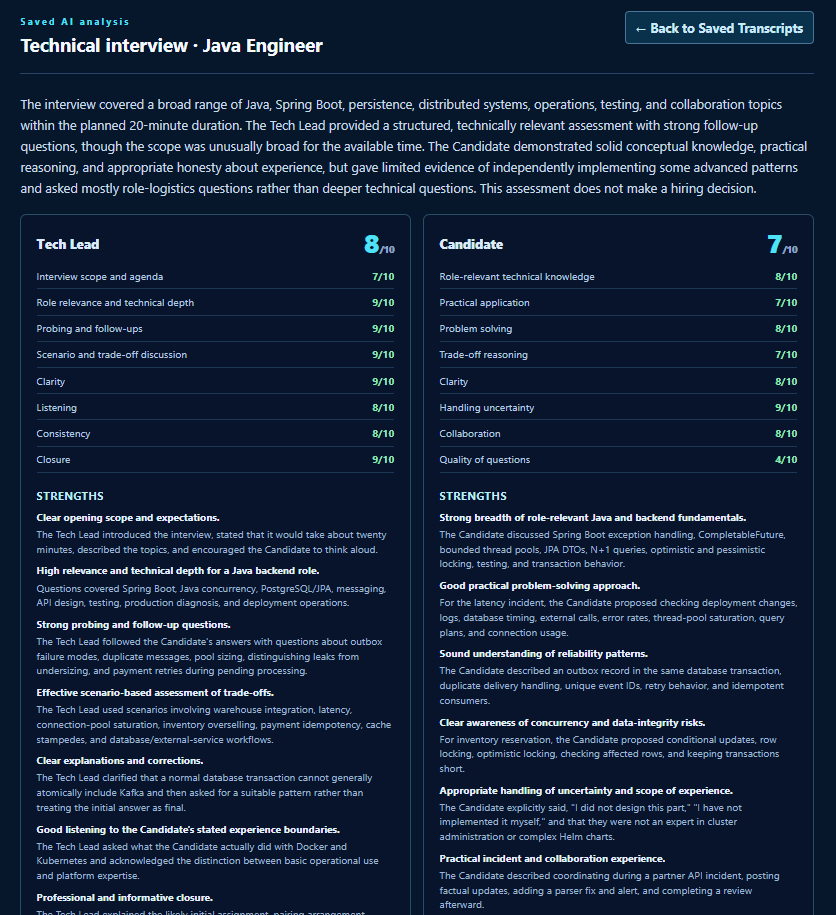
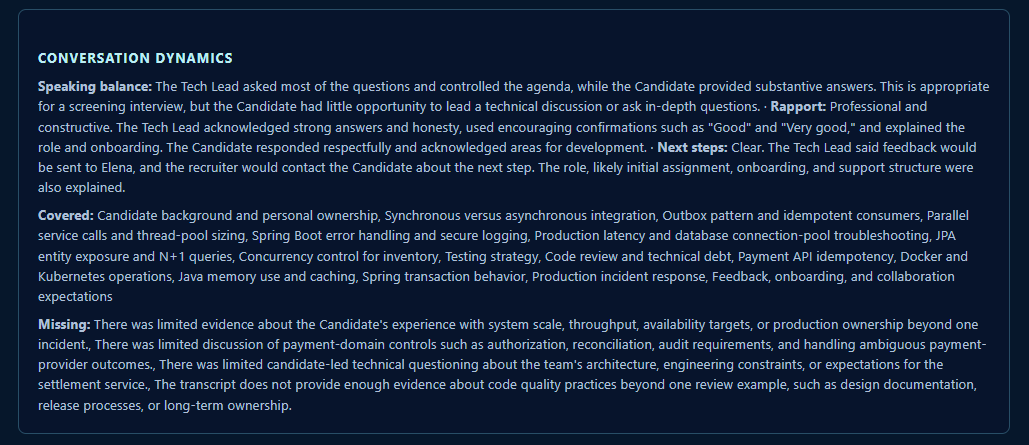
Saved, structured AI analysis
Review Recruiter, Tech Lead, and Candidate performance with 0–10 scores, strengths, improvement areas, and practical recommendations saved alongside each transcript.
Job Interview Analyzer
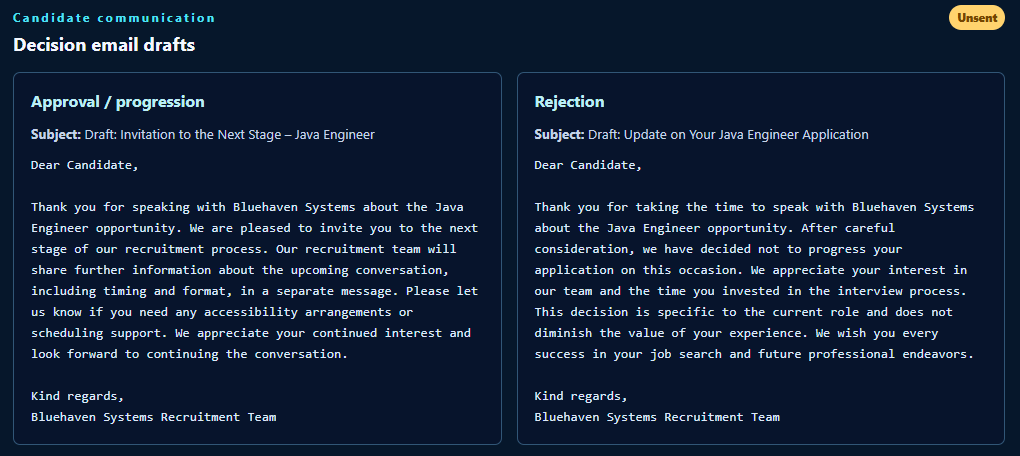
Human-controlled communication
Generate short approval and rejection email drafts after a technical interview. They remain clearly marked as unsent drafts for human review.
For recruiter screenings, the generator can vary English proficiency, the number of questions, and call duration. For technical interviews, it also varies the technical skill level of the Tech Lead and Candidate. This provides a useful range of scenarios for demonstrating and testing the workflow before real processes are connected.
Structured review
Analysis for both sides of the call
From the saved transcript library, a user can request analysis powered by GPT-5.6 Luna. The analysis is designed around the type of conversation rather than applying one generic scorecard to every interview.
Recruiter screening
Recruiter and Candidate
The analysis considers communication, role and process clarity, engagement, interview structure, and the quality of questions from both participants.
Technical interview
Tech Lead and Candidate
The analysis focuses on technical depth, relevance, communication, technical questioning, and practical opportunities to improve the interview itself.
Each participant receives a 0–10 score, together with strengths, areas for improvement, and recommendations. The result is saved against the transcript, so the original conversation and the resulting assessment remain connected. To protect consistency, a completed transcript cannot be analysed again.
Why GPT-5.6 Luna for this demo?
Job Interview Analyzer uses GPT-5.6 Luna, the lowest-cost model in the GPT-5.6 family. That is a deliberate fit for a demo that generates multiple synthetic transcripts and structured analyses while keeping experimentation economical. OpenAI positions Luna for cost-sensitive, high-volume workloads.
For an enterprise implementation, model selection should be tested against the organisation’s real interview formats, quality requirements, privacy controls, and evaluation data. GPT-5.6 Terra would be a strong candidate where a balance of intelligence and cost is needed; GPT-5.6 Sol would be the candidate for the most complex, high-stakes analysis. The appropriate model should be chosen through measured evaluation, not assumed from a tier name. See OpenAI’s current model guidance.
Candidate communication
Better follow-up, still human-led
Technical interviews can also produce short approval and rejection email drafts. These are generated as a practical starting point for candidate communication, then stored with the analysis. They are explicitly unsent drafts: a person reviews the content, makes the decision, and controls whether anything is communicated.
A practical next step
From demo to a bespoke recruitment solution
Job Interview Analyzer is a demonstration, but the more interesting opportunity is a tailored solution built around a company’s own recruitment process.
Many organisations are not yet using AI in recruitment—not because there is no need, but because off-the-shelf products do not reflect their interview formats, role requirements, evaluation criteria, approval flows, or data-governance expectations.
I would like to work with a company that wants to take its first practical step into AI-supported recruitment. Together, we could develop a bespoke version of this workflow around the organisation’s standards, existing systems, and the parts of the hiring process where its teams need the most support.
What a tailored solution could support
- Interview frameworks and scorecards specific to the company’s roles and hiring principles.
- Consistent, reviewable feedback for Recruiters, hiring managers, and technical interviewers.
- Human-approved follow-up drafts and workflows that fit existing recruitment operations.
Responsible implementation
Designed around people, process, and data.
A recruitment workflow should be designed around an organisation’s own policies and risk controls—not added as an isolated AI feature. A bespoke implementation can make those safeguards part of the workflow from the start.
Human review and accountability
People retain responsibility for interview assessments, hiring decisions, and every candidate communication sent.
Retention, notice, and access
Transcript retention, candidate notices, deletion processes, and role-appropriate access can be aligned to the organisation’s recruitment and privacy requirements.
Bias testing and improvement
Evaluation criteria and outputs can be reviewed against representative scenarios, then monitored and improved with feedback from recruiters and hiring teams.
Integration with the real process
The workflow can fit existing interview formats, scorecards, approval steps, and recruitment systems rather than asking teams to work around a generic tool.
Closing perspective
The new hiring standard should be better conversations
AI should not make recruitment less human. Used carefully, it can reduce the friction that prevents people from doing their best work: missed context, inconsistent feedback, repetitive administration, and vague follow-ups.
Job Interview Analyzer is a small but practical demonstration of that direction. The next step is to build a version around the real recruitment challenges of a specific organisation—helping its people listen better, assess more consistently, and create a clearer candidate experience.
Let’s talk
Build an AI-supported recruitment workflow that fits your team.
If your recruitment process does not yet use AI, we can start with a focused conversation about the interviews, tools, and improvements that matter most to your organisation.